Variable A
Demography
Population trends.
Bignona department · May 2025
Three qualitative scenarios - an eco-sustainable showcase, a Djiyito in transition, a granary in peril - and an associated action plan.
"Use the future to change the present to change the future." Territorial foresight is not a prediction: it is a method for anticipating possible developments and informing present action.
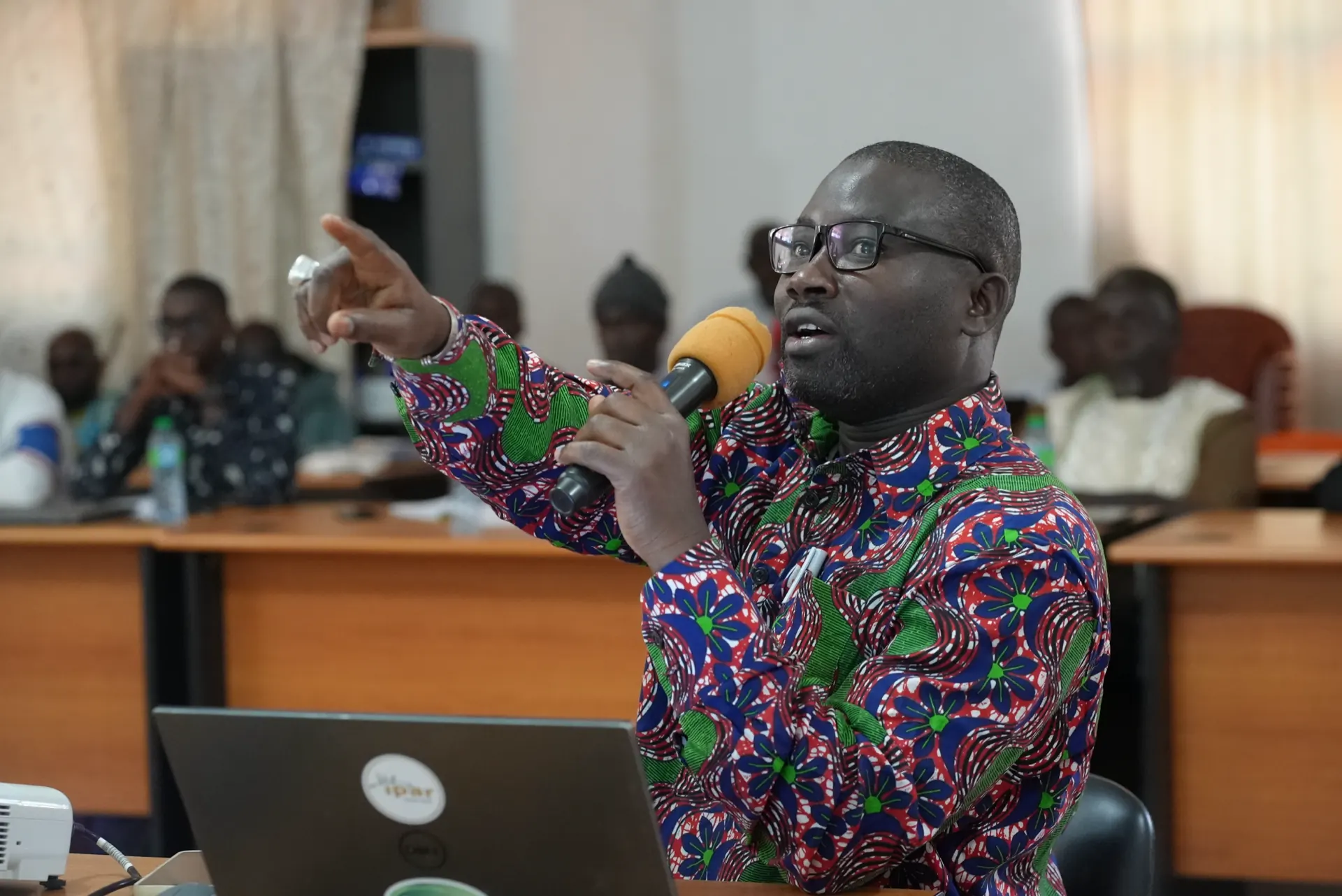
From participatory workshops held with 65 stakeholders of the DyTAEL Bignona, the ARTS consortium co-built in 2024-2025 three contrasted scenarios for the department's food systems by 2045. The approach, inspired by the CIRAD and CIFOR method, weaves living lab, collaborative research and back-casting.
Seventy-two change factors were identified and ranked by a structural influence-dependency analysis. Eight driver variables provided the warp of the scenarios. Four strategic levers were broken down into time-bound action plans assigned to specific actors - from the State to community-based organisations.
Main writing: Sidy Tounkara and Anta Faye (IPAR). Contributors: Younoussa Guèye (ENDA PRONAT), Joan Bastide and Patrick Bottazzi (UNIB).
This report is dedicated to the memory of Mouhamed Kaïraba Sonko and Honorable Fanta Sagna, committed to the DyTAEL of Bignona.
2045
Foresight horizon
65
DyTAEL participants
72
Change factors
3
Scenarios built
4
Strategic levers
Method
The CIRAD-CIFOR method, adapted by the IPAR-ENDA-UNIB team, articulates collective framing, factor identification, structural analysis, morphological construction and back-casting.
Step 01
Sharing the foresight method with the DyTAEL Bignona. Collective determination of the horizon (2045), the space (Bignona department) and the topic (food systems).
Step 02
"Which factors affect the Bignona food systems?" 72 factors identified and codified - social, technical, economic, environmental, political.
Step 03
Influence-dependency matrix to spot the 12 driver variables (highly influential, low dependency), 25 levers, 10 outcomes, 16 autonomous factors, 9 in the pack.
Step 04
Combining plausible states of the 8 selected driver variables, ruling out 208 incompatible combinations. Three contrasted, coherent scenarios.
Step 05
"What needs to happen for the desired scenario to come true?" Identifying the trajectories, events and actors to mobilise between 2024 and 2045.
Starting point
In 2024, demography is rising but agricultural renewal by youth is timid. Urbanisation is galloping and anarchic. Credit access is rising but the volume remains insufficient. Processing units are informal and barely profitable. Bush fires are slightly declining. Consumption is improving, oriented towards local species but under threat. Storage facilities and cold rooms are almost non-existent.
Scenario backbone
Out of 72 factors identified, 12 emerged as highly influential and weakly dependent. The 8 most structuring of these compose the warp of the three scenarios.
Variable A
Population trends.
Variable B
Generational turnover in farming.
Variable C
City growth onto farmland.
Variable D
Financing conditions.
Variable E
Processing infrastructure.
Variable F
Fire outbreaks.
Variable G
Diet trends.
Variable H
Conservation units to limit losses and manage availability.
Three possible futures
With 208 incompatible combinations ruled out, three contrasted scenarios emerge. DyTAEL stakeholders collectively chose "Bignona, an eco-sustainable showcase" as their horizon.
Desired scenario
A4 B6 C5 D1 E2 F1 G4 H3The optimistic scenario, chosen by DyTAEL stakeholders as the 2045 horizon to aim for.
In 2045
In 2045, demography is rising, younger and healthier. Agricultural renewal is effective, high, very professional and agroecology-oriented. Urbanisation is planned and harmonious. Credit access is easier and faster, with lower rates. Processing units are expanded, diversified, high-performing. Bush fires are nearly eradicated. The territory is networked with specialised storage and cold rooms. Agricultural policies are effective, research is participatory, agricultural advice digitalised and widespread.
Key markers
Intermediate scenario
A1 B3 C4 D2 E4 F5 G5 H2The intermediate scenario: a degraded status quo where agribusiness gains ground but community resource management holds out.
In 2045
In 2045, demography is stagnant, the workforce is ageing, training is costly. Land tenure remains stable for youth and women. Public policies are diversified but poorly owned by communities. Territorial governance is barely participatory. Soil fertility declines, agribusiness becomes intrusive, land grabbing develops. Food safety is reinforced, processing units more professional, urbanisation contained. Consumption opens to other cultures and local consumption retreats.
Key markers
Unwanted scenario
A3 B5 C2 D4 E6 F3 G3 H6The worst-case scenario: rising demography but no agricultural renewal, land grabbing fueling conflicts, anarchic urbanisation, mass rural exodus.
In 2045
In 2045, despite rising demography, agricultural renewal by youth is non-existent. Rural exodus and illegal migration intensify. Public policies are ill-suited, agricultural research under-funded. Water resources are insufficient, hydro-agricultural infrastructure dilapidated. Peasant seeds become inaccessible. Soil fertility, salinisation, sand encroachment and the fruit fly worsen. Deforestation is excessive. Agribusiness becomes a source of land conflicts. Epidemics develop.
Key markers
2025-2045 action plan
The desired scenario only comes true if stakeholders act now on four strategic levers, broken down into precise priority actions.
Essential pillar for driving qualitative agroecological change. Performing educational system, agroecology and climate change in curricula.
Priority actions
Strategic actors to enlist
State (Education and Agriculture Ministries), Academic Inspectorates, Local councils, ISEP Bignona, UASZ, Émile Badiane Technical Agricultural High School, DyTAEL Bignona, Peasant organisations.
Effective health system with promotion of agroecology and a healthy diet based on local products - positive impact on health, demography and population movements.
Priority actions
Strategic actors to enlist
State (Health, Agriculture and Trade Ministries), Health district, Badiénou Gox Yi, Local councils, Community-based organisations, Food Technology Institute, UASZ, DyTAEL Bignona.
Land management, regulation of space occupation and control of urbanisation to anchor harmonious territorial development.
Priority actions
Strategic actors to enlist
Central State, National Assembly, Water and Forests service, ANRAC, Djibélor CRA, UASZ, ISEP Bignona, Local councils, CBOs, Peasant organisations.
Financial products that integrate youth-specific needs; lighter conventional mechanisms and promotion of community-based financing sources.
Priority actions
Strategic actors to enlist
Agricultural Bank (LBA), DER/FJ, 3FPT, CNAAS, Central State, Private sector, Technical and financial partners, GPF, AVEC, tontines.
To close
The 4 levers align with the goals of Senegal's 2034 Food Sovereignty Strategy (SSA): productivity, valorisation, research/innovation, governance.
The DyTAEL Bignona has a clear vision: "by 2036, Bignona reaches well-being in a dynamic and sustainable environment through agroecology." The desired scenario fits this line.
Forum theatre staged and discussed the most controversial change factors (land grabbing, bush fires, mangrove felling, roaming livestock, seeds, fishing practices) - easing collective ownership.
The results must be popularised and shared with local and national decision-makers. A culture of anticipation is a lever for shaping tomorrow today.
Team
Main authors
Contributors
Foresight facilitation
Observer
Patrick Bottazzi (UNIB)
Participation
65 DyTAEL Bignona stakeholders
Producers, women processors, herders, fishers, councillors, researchers, youth, women.
To cite this document: TOUNKARA S., FAYE A., GUÈYE Y., BASTIDE J., BOTTAZZI P., 2025, Exploring possible food futures for the Bignona department in 2045. What qualitative scenarios for acting now?, ARTS Consortium (IPAR, ENDA PRONAT, UNIB), May 2025.
Keep reading
This foresight dialogues directly with the July 2024 mapping of agroecological initiatives and fed the July 2025 Bignona artistic residency. Three stages of one process.