01 Improvisation
Land tenure and collective memory
Two men discuss land tenure and land grabbing, reaffirming the DyTAEL's critical role on the issue.
- accaparement
- mission
- communication
- DyTAEL
04 · Collective creation DyTAEL Bignona × Ka-Reng × ARTS
The story of a forum theatre play built step by step - from the foresight seminar to the public preview at the agricultural high school - to stage the issues of land tenure in Casamance.
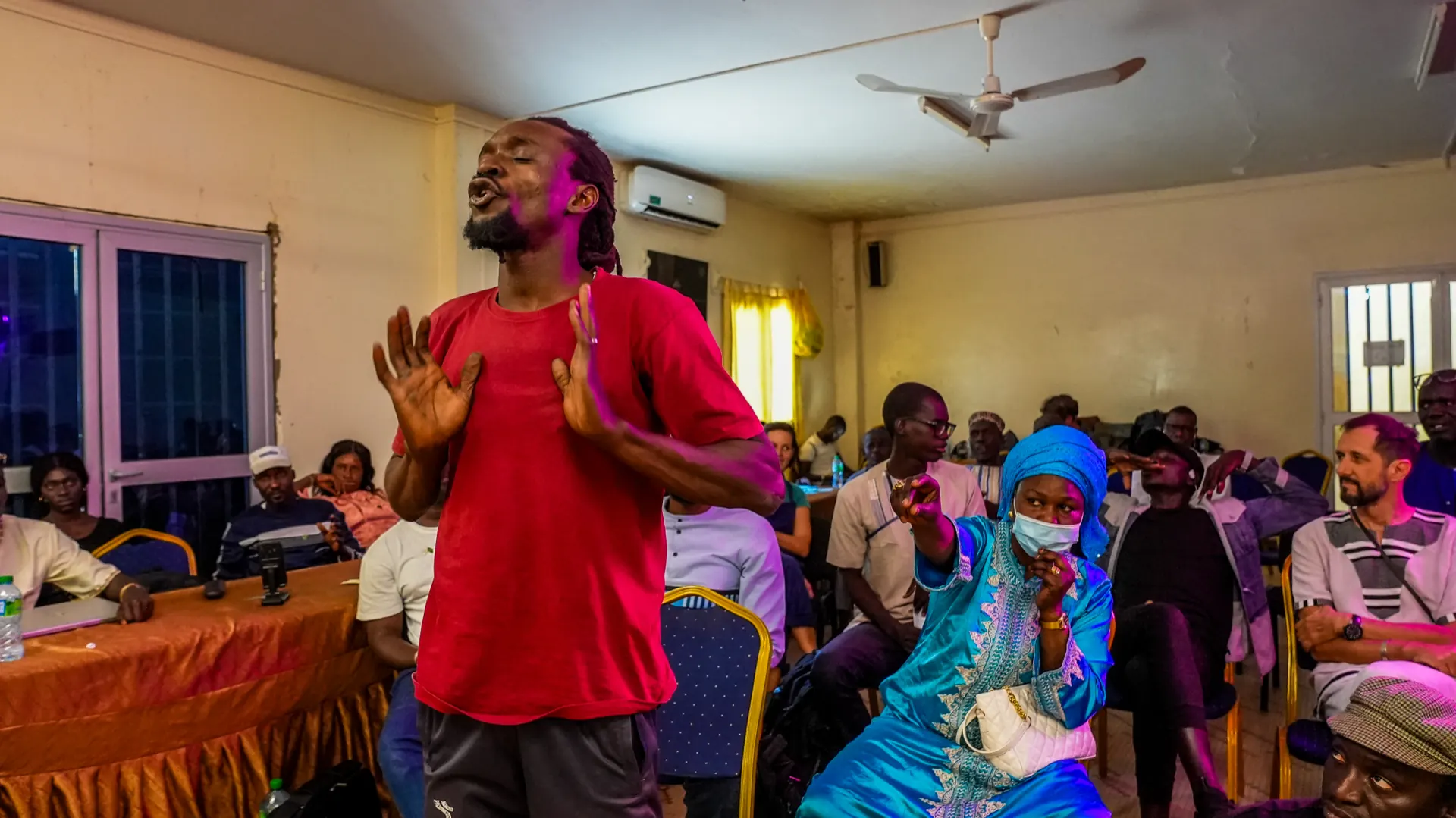
In Bignona, Senegal, within a citizens' organisation, the DyTAEL, an amateur group uses theatre to raise awareness of land grabbing and to defend a peasant agroecology.
Unlike the classic "theatre for development" current (TfD), which is often commissioned by an institution, this play is a community-led initiative carried by the DyTAEL and supported by ARTS, crafted step by step in co-production.
Theatre is, above all, an art of speech, at the crossroads of taboos (ñenye in Joola Kassa), progressive words, frankness and respect for oral traditions. It is also an art that puts forms of knowledge on an equal footing: whether you are a scientist, a peasant, an entrepreneur, a politician, an agronomist, from Casamance or elsewhere, everyone takes part in reading the real.
Why theatre
The theatre method sets rules of play - on speech, body, silence and fiction - that open a space of political expression rarely available elsewhere. These principles guide each of the workshops.
Theatre is an art of speech, at the crossroads of taboos (ñenye in Joola Kassa), progressive remarks, frankness and respect for oral traditions.
Unlike formal public speech, theatre can denounce a behaviour with humour where it would be received elsewhere as an attack: this is the strength of the distance offered by the fictional role and the costumes.
Playing a role other than one's own - the principle of catharsis. The stage emancipates by letting us try roles other than the one assigned to us in daily life, and therefore other forms of agency.
The art of theatre also rests on the unsaid, on what is hinted at. On stage, silence weighs as much as words: it arbitrates between scholarly speech, everyday speech and a silence that speaks.
Theatre is above all a bodily art. Gaze, facial emotion, movement, interaction: the body is a language in its own right. This is what lets theatre reach audiences who don't speak the language being performed.
Theatre claims no lessons but states a problem with force - it is a tribunal in itself. By pushing the scene to its peak, it triggers in the audience the need to act in order to do justice to a problem.
From the testimonies, compose a meaningful scenario: subtle enough to feel real, broad enough to address several themes. Not quantitative but qualitative, with spatial and temporal scales calibrated for concrete action.
Creative and sensitive, theatre opens space for the other arts present in the culture - song, dance, agricultural rituals - and carries the performance's languages (Diola, Wolof, French) as a sovereign community strength.
In video

A 14-minute report on the collective creation in Baïla. The camera follows the emerging Bignona DyTAEL troupe: improvisations, testimonies from the amateur actors, working sessions with Ka-Reng, and evenings around the fire that matter as much as the formal rehearsals.
The method
01
8-10 October 2024
Bignona Town Hall
Who
65 people - DyTAEL + Ka-Reng theatre company + ARTS consortium
Why
One day of theatre within a 3-day territorial foresight programme led by IPAR
02
29-30 January 2025
Bignona Town Hall
Who
50 people - DyTAEL + Ka-Reng + ARTS
Why
Setting up an amateur theatre troupe within the DyTAEL membership
03
3-5 March 2025
Baïla - residency at campsite
Who
17 people - DyTAEL troupe (12) + Insa Bodian & Lansana Sacouboté (Ka-Reng) + Lise Landrin, Yunuça Gueye, Selbé Faye & Ousmane Pape Diallo (ARTS) + storyteller François Ménager
Why
Collective creation of the play on land tenure
04
11-12 April 2025
Maison de l'innovation, Bignona
Who
40 people - troupe + Bignona DyTAEL + Ka-Reng + ARTS
Why
Presentation to the DyTAEL community and integration of scientific and civic feedback
05
13-14 April 2025
Bignona Agricultural High School
Who
75 people - DyTAEL troupe + Mlomp women's troupe + Ka-Reng + ARTS + high school audience
Why
First public theatre forum performance, encounter with the Mlomp troupe
Those who made it happen
A peasant troupe from the Bignona DyTAEL, supported by the Ka-Reng company (Ziguinchor) and the ARTS team: researchers, storyteller, camera operator. The play is held collectively, in several languages, on several stages.
12 performers - 3 women, 8 men
25% women in the troupe, compared with 13% in the full DyTAEL assembly
The report mentions 12 people - 8 men, 3 women - i.e. 25% women in the troupe, against 13% in the full DyTAEL assembly. The complete nominal list will be published after DyTAEL validation.
Identified performers
Dev Sagna
Actor - farmer, DyTAEL Bignona
Bintou Badji
Actress - DyTAEL Bignona
Djibril
Actor - senior, DyTAEL Bignona
Facilitators and method
Insa Bodian
Ka-Reng theatre company (Ziguinchor)
Artistic director - workshops and forum facilitation
Lansana Sacouboté
Ka-Reng theatre company
Facilitator of the residency workshops
Adja Dienaba Coly
Ka-Reng theatre company
Facilitator of the October 2024 day
François Coly
Ka-Reng theatre company
Facilitator of the October 2024 day
Ibrahima Fayinké
Ka-Reng theatre company
Facilitator of the October 2024 day
Lise Landrin
ARTS - University of Bern (GIUB)
Theatre-research method, report writing
François Ménager
Independent storyteller
Present at the Baïla residency - storytelling evening
Report credits
Stage 3 · Method
A writing without writing - the text is made in body, on stage, through improvisation.
Stage writing is a method of collective scenario writing through the stage itself: through improvisations, exchanges, discussions. No prior text exists, unlike in classical dramaturgy. The actresses and actors are at once performers, directors and creators.
This body-writing always rests on warm-ups and games to develop expressiveness, then on a series of improvisations that exhaust the theme as exhaustively as possible. It selects, removes, adds and starts over until a satisfying form is found.
In the end, every performer knows their entrance and exit cues but stays free in the words spoken on stage. The play remains orally transmitted, never frozen in writing - which makes it adaptable to each new context.
Stage 3 · Day 1
To explore the theme of land tenure, the troupe improvised thirteen sketches in a single day, with no prior text. Each one addresses a facet of the same subject: family, gender, generations, plural authorities, corruption, return to the land, the market, ecology. The final play grew out of the confrontation of these sketches.
Two men discuss land tenure and land grabbing, reaffirming the DyTAEL's critical role on the issue.
A brother returns to claim his land but the other refuses. The land belongs to whoever tends it, not to a person. The village chief decides in favour of the brother who used the land.
A young man returns from Dakar to his native village but the family has occupied all the land. He cannot set up his agroecology project. The old man refuses to understand.
A herder has nowhere to lead his cattle; the farmer is fed up with seeing his fields eaten and poisons the herd. The customary chief rules - but has been bribed by the herder.
Three women try to obtain land from a wealthy husband who owns many fields. They contemplate going around him legally to farm.
A widow seeks land from her brothers-in-law to run a DyTAEL-funded project. A man steps in to support her. The land is loaned conditionally, not granted.
A man sells the same plot to two different people and tries to escape. Administrative chaos ensues.
Conflict over illegal large-net fishing; women confront fishers using banned nets. What alternative?
A young man tries to register a land title but doesn't know how. The DyTAEL technician walks him through the procedure (long and bureaucratic).
Young men want to deforest to make charcoal. The tree starts to speak - terror! A village woman convinces them to convert to agroecology.
A son wants to start a motorbike-taxi business (Jakarta). Parents try in vain to dissuade him. He is convinced to try farming and ends up combining both.
Two vendors confront each other - organic vs cheaper conventional. A man buys conventional, returns disappointed, switches to organic. The difficulty of advocating for organic and its price.
Brothers return from Dakar and want the land to be split equally. The brother who stayed on the farm says: "if you want the land, come work it." Illustration of the "diola cravate" archetype.
Stage 5 · Forum theatre
A West African forum theatre technique: the audience judges each character at the end of the performance. On 13 April 2025 at the Bignona agricultural high school, 70 spectators delivered their verdicts. You can cast your own vote below.
How it works
Forum theatre opens with the trial of characters. For each role, the audience decides: in the shade (positive), at the centre (mixed), or under the burning sun (harmful). Cast your vote and compare it with the verdict delivered by the Bignona high school audience in April 2025.
🌑 In the shade
Behaviour beneficial to society
◐ At the centre
Mixed, divisive behaviour
☀ Under the burning sun
Has harmed society
Rules over land disputes but has been bought off by foreign investors and wealthy livestock farmers.
Your verdict
Covers up the corrupt chief's acts and is complicit in the system.
Your verdict
Denies the young woman access to land in the name of tradition. "No husband, no land."
Your verdict
Seeks land to run her agroecology project. Faces resistance from the family and patriarchal system.
Your verdict
Comes back from Dakar to claim family land without knowing the work of farming. Opportunist.
Your verdict
A character added at the last minute to speak to the high school audience - embodies the future of the transition.
Your verdict
Short on grazing land, bribes the customary chief to let his herd through.
Your verdict
The sister play
« The women's fight for land »
In Mlomp, the PROCASEF (National Land Tenure Security Programme) is registering land titles in 2025, while customary rights have a different ancestral governance. Women, sidelined from the process, staged a drama piece to put their questions to the public: who owns the land? What will happen if we start selling it? What will become of land not declared in 2026? Does the new governance respect the sacredness of the land?
Troupe · Mlomp women's troupe (Oussouye)
Duration · 1 hour drama performance
Premiere · 27 March 2025 - World Theatre Day
Support
Voices from the troupe
"It's all right - because I have faith in theatre."
"I wasn't the best, I'm still not the best. But when the troupe was being formed, I was outside doing an interview - and the room unanimously named me. Out of respect, I had to answer their call. I arrived without knowing where to go, what to do or how. It was like a child learning to walk."
"At first I thought: at my age this is a bit much. But then I thought, it's for a good cause. Since we've committed to sustainable development through agroecology, why not. It'll be my modest contribution so that tomorrow our children and grandchildren live in a better world."
"Through theatre, you can solve many problems and find solutions. It is a mechanism for writing down what is blocking us: we step out of school and onto the stage. Today, everyone had something to say - and what each person said carries weight."
"The question of urbanisation, jobless youth, rural and urban exodus, agricultural succession, farmer/herder conflicts and roaming livestock, but also women's access to land, community conflict resolution, foreign and national land grabbing with local complicity: it's all there."
"I can say ARTS is a good project, because knowing that some people care about us, about our generation, that's very important. It gives us confidence, it makes us want to keep fighting. When we see our elders cheering us on, we want to push forward."
"You need to add more dancing and singing: these are media that touch the human heart. And costumes really matter - the play is going to be performed beyond the department."
"It's a feeling of satisfaction. Since we set up the Bignona DyTAEL, today is when we really started to mark where we want to go. With forum theatre, we'll get the chance to reach the widest audience, and that audience will help us carry our message forward."
"That's what's extraordinary: we managed to pull out the essence of all the problems we live today in Casamance, and in Sahelian countries more broadly. We could prioritise the problems, and these are the problems we tried to translate into a play."
What's next
The Bignona DyTAEL troupe is preparing the regional tour of Land that everyone covets. The dates below are set; others are under discussion. The forum itself adjusts to each new audience.
Planned
Festival of Forests and Mangroves
Diouloulou (Casamance)
Planned
Festival of Urban Cultures
Sindian (Casamance)
Further reading
The theoretical and empirical references that nourished the project - from Augusto Boal's theatre of the oppressed to Lise Landrin's work on theatre as a geographical method, by way of political agroecology in Senegal.
Boal 2004
Boal A. (2004) Games for Actors and Non-Actors: Practice of Theatre of the Oppressed (transl. from Portuguese). Paris: La Découverte.Boal 2014
Boal A. (2014) Theatre of the Oppressed. Paris: La Découverte.Bottazzi & Boillat 2021
Bottazzi P. & Boillat S. (2021) Political Agroecology in Senegal: Historicity and Repertoires of Collective Actions of an Emerging Social Movement. Sustainability 13(11): 6352.Diol et al. 2022
Diol M., Fernandes A. & Crosato M. (2022) The Social Theatre Toolbox. Research report on social theatre practices in West Africa. Yenna.org.DyTAES 2020
DyTAES (2020) Contribution to national policies for an agroecological transition in Senegal. Policy brief for decision-makers.Epskamp 2006
Epskamp K. (2006) Theatre for Development: An Introduction to Context, Applications and Training. London: Zed Books.Fall-Sokhna & Thiéblemont-Dollet 2009
Fall-Sokhna R. & Thiéblemont-Dollet S. (2009) Gender in Senegal: an emerging research object? Questions de communication 16: 159-176.Landrin 2019
Landrin L. (2019) Triggering, representing, restituting: theatre as a geographical method. Cybergeo: European Journal of Geography. DOI: 10.4000/cybergeo.33530.Landrin 2021
Landrin L. (2021) Putting oneself at play. Inquiring into rural Nepal through trigger theatre. PhD thesis, University of Grenoble.Long 2001
Long N. (2001) Development Sociology. Actor Perspectives. New York: Routledge.McAuley 2012
McAuley G. (2012) Not Magic but Work: An Ethnographic Account of a Rehearsal Process. Manchester: Manchester University Press.What's next
Beyond land tenure, this project strengthened the collective and opened paths for other forms of advocacy. Embodied approaches, which work through story and emotion, help build shared understanding and support lasting transformations.