02 · Participatory mapping
A platform for an agroecology directory
109 geo-referenced agroecology initiatives across the two ARTS territories, Mbour and Bignona.
Many agroecology initiatives stay isolated, little known beyond their immediate context. Geo-referenced mapping aims to make them visible: a maintained directory that records the actors, documents local efforts and helps connect them.
Identification starts within the DyTAELs - territorial citizen platforms that collectively spot initiatives in their department. The research teams then visit each one in person, conduct an in-depth interview and complete a detailed survey: practices, challenges, precise geolocation, stakeholders.
The data feeds an interactive mapping platform. Each initiative gets its own record. Decision-makers, researchers and partner organisations can explore the geographic distribution, cross-reference practices, identify complementarities.
Platform designed and built by Joan Bastide (GIUB) · 100% open source · decentralised by the DyTAELs, aggregated by the DyTAES.
State as of May 2026
Key figures
109
Mapped initiatives
2
ARTS living labs
43.7%
Women surveyed
100%
Geocoded
OSS
100% open source
The database holds 109 records. The final report submitted to the SOR4D programme states 106: that is the figure as it stood when the report was filed, and the one carried on the home page.
Embedded map
Explore the 109 initiatives
Interactive map directly on the page - filter by territory, each marker opens a card with the name, commune, actor type, year and a link to the full atlas.
The interactive map could not load in this browser. The list of initiatives is still available below.
Open the full atlas ↗Territories
- Mbour
- Bignona
See the text list of all 109 initiatives
- ACCES M · 2009
- ACCES · Sindia B · 2005
- Agri Avenir · Bignona B
- Agri karacene · Tanghori B · 2023
- Agrosaab · Mbour M · 2023
- Aire protége de kholpa · Diass M
- Aire protegee de Groupement book Jom tanguis · Sindia M · 2011
- Aire protegée de babel · Sindia M · 2011
- Aire protegée de GIE de Takou liguey Daga Dialaw · Diass M
- Aire protegée de GIE ndiogaye · Sindia M · 2011
- Amdallah · Nguekhokh M · 1992
- APAD (Association des Planteurs de l'Arrondissement de Diouloulou) · Diouloulou B · 1986
- ASAPID (Association d'Appui aux Initiaves de Paix et de Développement) B · 2011
- Association des agroecologistes SAAFI · Diass M · 2017
- Bawii tawfekh · Kataba 1 B · 2023
- Beer Sheba · Sindiara M · 2012
- Binte famille B · 2023
- Bloc maraîcher Grand Kalounaye · Oulampane B · 2016
- Cambo Mboulem · Malicounda M · 2017
- Casa ecologie · Bignona B · 2007
- Casa Écologie · Bignona B · 2014
- Casa nature · Coubalan B · 2022
- Casa nature · Koubalan B
- Cause premiere (Ferme ecole intégree ) · Nianguiss B · 1995
- Centre départemental des handicapés de M’bour · Mbour M
- Coin bio · Ngaparou B · 2024
- Coin Bio · Ngaparou M · 2024
- Conseil départemental B
- Coopérative de service multifonctionnelle Bandial Hadj · Thionck Essyl B · 2014
- Cooperative koumangola · Thionk essyl B · 2022
- Cooperative scoop ca le.Jaardin de NianninG · Malicounda M · 2015
- CPS - ASTUT agrifood startup scale up · Mbour M · 2019
- CREATES · Sindia B · 2024
- D3emballage · Ngaparou M · 2020
- Dij@gro M
- Dij@gro · Mbour M · 2020
- Dione Agribio services · Sandiara M · 2020
- Djigou sahel · Fissel M
- DK Bio production · Thionck Essyl B · 2019
- ECO CAMP · Somone M · 2019
- Eco from Africa · Tenghory B · 2019
- Ekambouleck B · 1982
- Établissement Binte et Famille · Kataba B · 2018
- Exploitation familiale de adama gueye · Fissel M
- Faylar teranga agro · Sandiarq M · 2020
- Fédération des femmes de Ngaparou · Ngaparou M · 2020
- Ferme agroecologique Fangoundémassilo B · 2016
- Ferme des qu’âtres chemins · Yenn M · 2016
- Ferme Diémé Kamanar ou Bourougoune · Thionck Essyl B · 2022
- Ferme djiwalo B
- Ferme familiale Sané Koutengor · Tenghory B · 2018
- Ferme Fipa · Nguekhokh M · 2016
- Ferme kekendo · Diouloulou B · 2018
- Ferme villageoise Boulandor · Ouonck B · 2018
- Galle mame Samba · Mbour M · 2019
- GIE bokk Diom · Sindia M
- GIE Boul Faalé Niafourang · Thionk Essyl B
- GIE Claire · Tanghori B · 2013
- GIE Djiwalo · Think Essyl B
- Gie Kawtal Agro · Mbour M · 2003
- GIE Poumolindiana ostreiculture B · 2014
- GIE Takou Ligeyy · Ngeniene M
- Gie. Boufalé · Kataba 1 B · 2021
- GPF Fakh ya well - champs agroforesterie · Fissel M · 2007
- GPF garam · Sindia M
- GPF. Batine Bah · Thionck Essyl B
- Graines à papilles · Sindia M
- Groupement book Diome · Sindia M · 2022
- Kaanki · Sinda M · 2017
- Karonghen · Oulampane B · 2023
- Karonghen 4 · Oulampane B · 2023
- Karonghen Foulouck · Djibidione B · 2013
- Keparu Ngane · Ngaparou M · 2018
- Khour yi · Fissel M · 2019
- La ferme · Saly M · 2015
- Laudato Si Agro Eco · Sandiara M · 2022
- Les bassins verts de Nianing · Malicounda M · 2017
- Mala · Kafountine B · 1994
- Mame Modou Lena · Ngaparou M · 2009
- Marlé · Oulampane B · 2023
- Mbokk yaye · Rendel M · 2003
- Nawell Wass · Mbour M · 2021
- Nutrivie · Sindia M · 2012
- Pas de nom · Fissel M · 2006
- Plant’art · Mbour M · 2010
- Poumolindiana · Kafountine B · 2014
- Production de tomate hivernale M · 2000
- Producttion de tomate hivernale · Diass M
- Projet lutte contre la soudure et l'endettement · Fissel M · 2007
- Ptojet de renforcement de l'entreprenariat social pour la lutte contre la soudure et l'endettement · Sandiara M · 2014
- Ranch Salikh · Nguekhokh M · 2015
- Reseau de femmes de nguekokh · Nguekokh M · 2018
- Rosalie confiture · Sindia M · 2002
- S’en Bassil · Mbour M · 2020
- Salimtoo wellness · Mbour M · 2021
- Sarr agro · Sandiara M · 2021
- SCPEA (Société de commercialisation de produits agricoles et d'évage) · Ouonck B · 2018
- SDDC · Mbour B
- Societé cooperative, genre des groupements féminins et entreprises du Blouf · 6 communes thionk essyl, mangagoulack, balingor, diegoune, karthiack, mlomp, B · 2022
- Sokhna Mai · Malicounda M · 2014
- Summu agribuisness · Sandiara M · 2020
- Tolou bour · Malicounda M · 2023
- Tolou keur · Sindia M · 2021
- Tolou malick faye · Malicounda M · 2014
- Traoré Agro business · Saly M · 2007
- Union des GIE AJAC-Kalounaye · Ouonck B · 1982
- Union des GPF de l'arrondissement de Diouloulou · Diouloulou B · 1988
- Yacine Agro Services · Sandiara M · 2010
- Yeesal agro · Saly M · 2007
Data: ARTS field surveys up to May 2026 - DyTAEL Mbour & Bignona. Tiles by OpenStreetMap.
Three windows
Three windows on the territories
The live atlas offers three complementary views: an aggregated national reading for the DyTAES, and two local views autonomously managed by the DyTAELs. Each DyTAEL controls its inventory; the national view federates them.
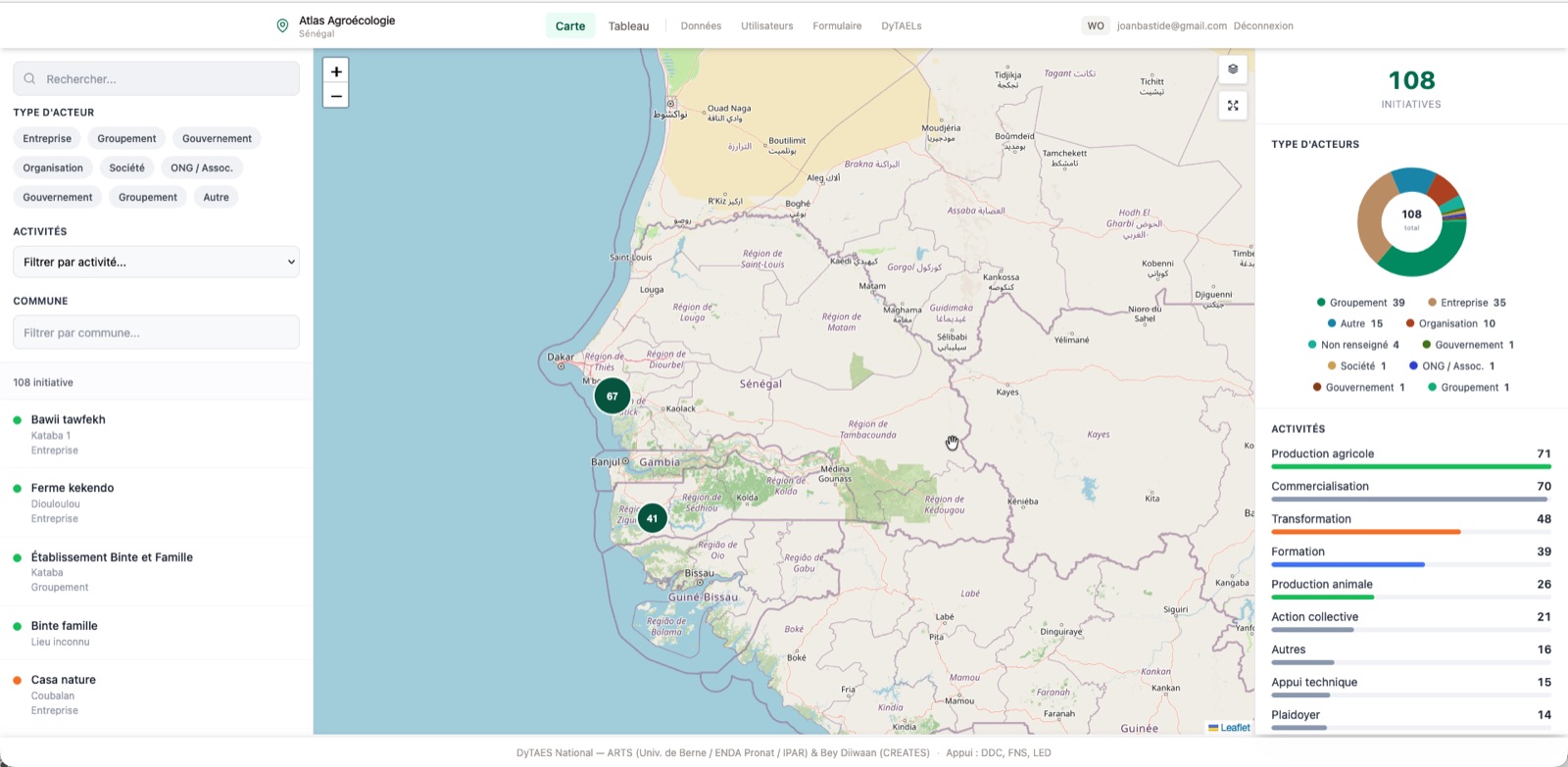
108
initiatives
Senegal · DyTAES
National
Aggregated overview. Every DyTAEL feeds this national panorama.
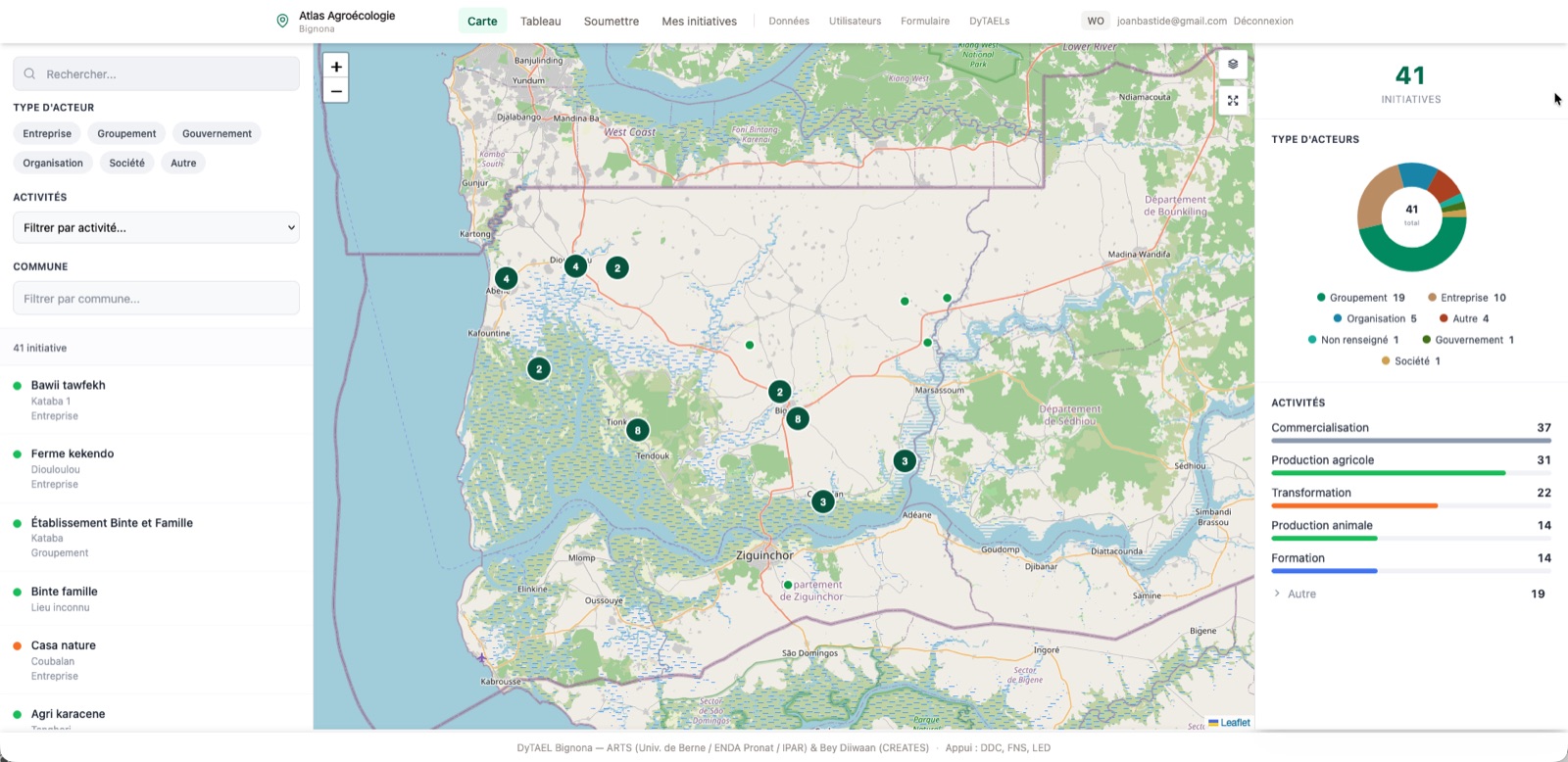
41
initiatives
Casamance · DyTAEL
Bignona
ARTS Casamance living lab. The Bignona DyTAEL runs its own local atlas.
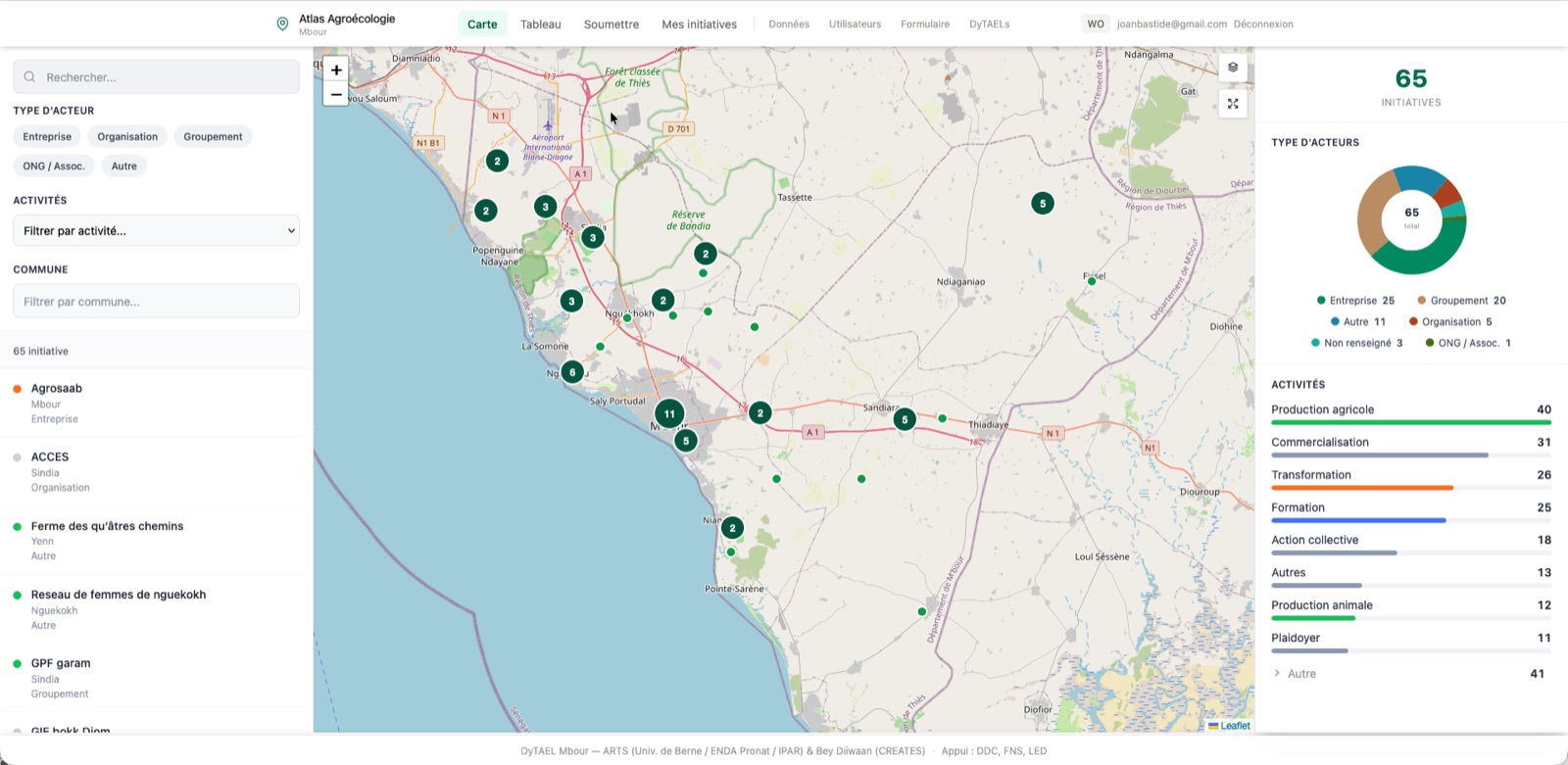
65
initiatives
Petite Côte · DyTAEL
Mbour
ARTS Petite Côte living lab. The Mbour DyTAEL pilots its territorial inventory.
Each of the project's two platforms has its own page: DyTAEL Bignona and DyTAEL Mbour-Petite Côte.
The tool is being reused beyond ARTS. The Rufisque DyTAEL has opened its own atlas on the same platform.
What the data says
Five readings of the field
Beyond the dots on a map, the surveys produce richer data: who carries the transition, since when, on which links, with which practices. Five readings complement the map.
Growth
When did initiatives start?
83 dated initiatives · 2000-2024
- Mbour (64)
- Bignona (45)
Actors
Who carries agroecology?
Collectives and family businesses dominate - the State is almost absent.
- Collective 39 · 36%
- Family business 36 · 33%
- Other 15 · 14%
- NGO / Association 12 · 11%
- Unspecified 4 · 4%
- Government 2 · 2%
- Company 1 · 1%
Gender
Who answers the survey?
103 respondents interviewed door-to-door
-
45 women · 43.7%
-
58 men · 56.3%
- Close to parity in the field - well above the share of women in official deliberative assemblies.
Value chain
Where do initiatives sit on the chain?
109 initiatives - most cover multiple links
- 01 Agricultural production 71
- 02 Trade 68
- 03 Processing 48
- 04 Training 41
- 05 Livestock farming 26
- 06 Collective action 24
- 07 Technical support 18
- 08 other 17
Practices
What does "agroecology" mean on the ground?
Top 8 practices reported by the initiatives
- 01 Organic fertilisation 57
- 02 Crop rotation 52
- 03 Agroforestry 40
- 04 Gestion_raisonnée_de_l'eau 38
- 05 Mulching 30
- 06 Culture_intercalaire 26
- 07 Utilisation_de_variétés_locales 25
- 08 Recyclage 21
Participatory method
How the data is made
Four stages to move from the citizen workshop to a point on the map. The entire chain is open source, taken over by the DyTAES to extend the inventory to the whole country.
-
01
DyTAEL workshop
The local citizen platform collectively identifies agroecological initiatives in its territory - farmers, processors, organisations, young ventures.
-
02
Visit and interview
The ARTS team visits each initiative, conducts an in-depth interview and completes a detailed survey: practices, challenges, precise geolocation.
-
03
Geocoding and record
The data is uploaded to the dedicated mobile app. Each initiative gets its bilingual record and its point on the map.
-
04
Publication and uptake
The atlas goes public. The tool is handed over to the national DyTAES, which extends it to other territories - Rufisque has already opened its own atlas beyond ARTS.
A transferable platform
Decentralised · Aggregated · Open source
Each DyTAEL runs its atlas autonomously. The DyTAES centralises and aggregates for national advocacy. The code and data are open so that other territories - like Rufisque - can take it up in turn.