ARTS

Mbour, Petite Côte · 18 - 20 February 2025

Agroecology on stage

Three days to collectively diagnose the blockages in Petite Côte food systems, stage them through forum theatre, and chart a 2050 vision.

On Senegal's Petite-Côte, the agroecological transition is not only a technical matter. It is rooted in a territory shaped by memory, tension and expectation, under heavy land pressure and the erosion of natural resources.

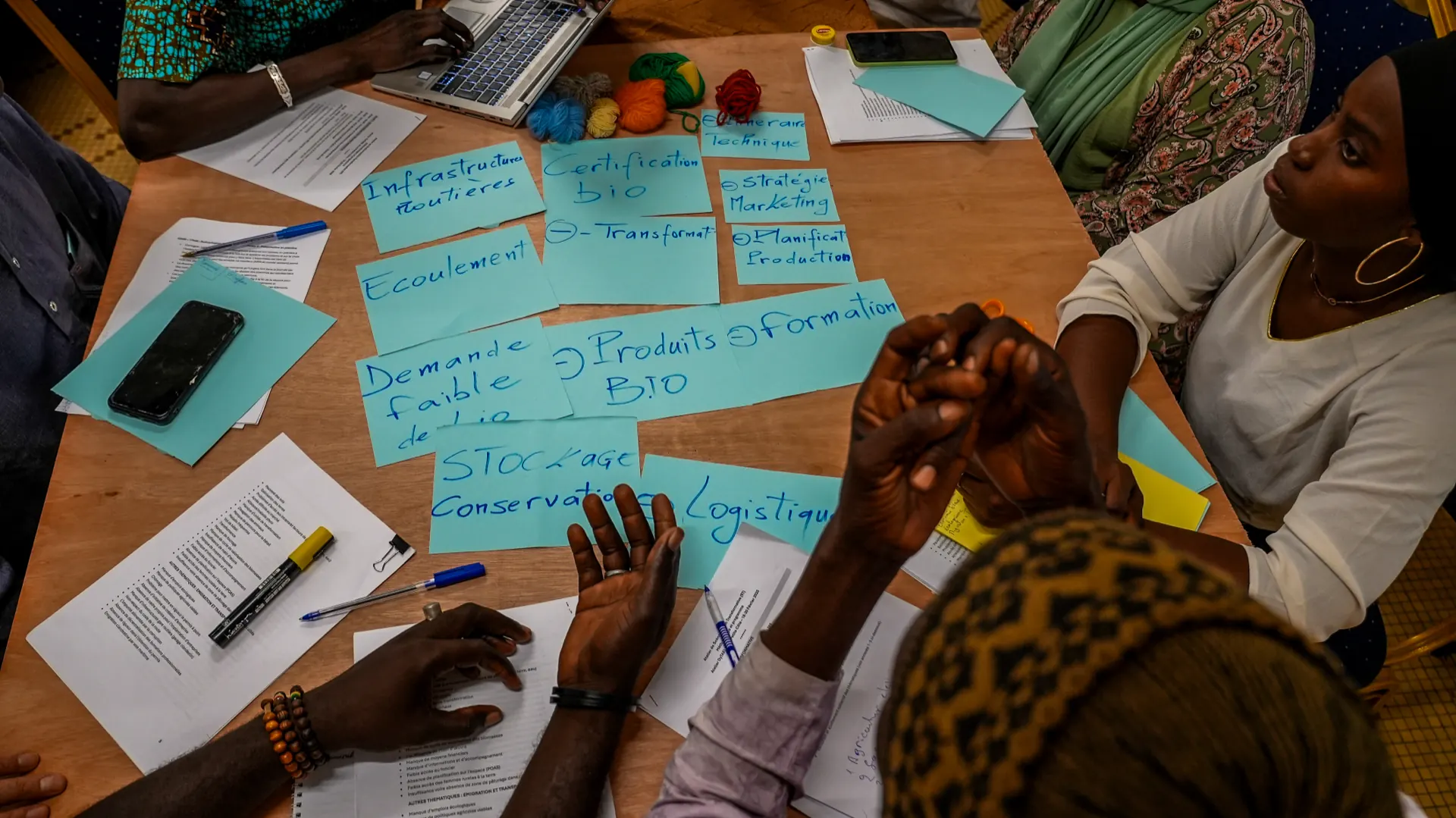
The transformative scenario workshop, held in Mbour from 18 to 20 February 2025, draws on participatory methods that let hoped-for futures emerge from the ground up. The approach mobilises imagination, emotion, play and life stories: forum theatre and Oddia's live drawings play a central role.

Five thematic axes were retained by the participants: agriculture and livestock, land tenure and natural resources, value chains, fishing and coast, tourism and circular economy. For each axis: the problem tree, the impact-feasibility matrix, then the theatrical staging.

Coordinated and written by Patrick Bottazzi, Lise Landrin, Joan Bastide.

3

Workshop days

5

Thematic groups

5

Forum theatre plays

7

Action types

2050

Vision horizon

Method

Seven steps of transformative scenario-building

Drawing on participatory action research, territorial strategic planning and Boal's community theatre, the method moves past sectoral framing to make room for collective intelligence.

  1. Step 01

    Co-identifying priority issues

    Collective brainstorming in plenary to surface the main threats to Mbour's food systems: resource degradation, land insecurity, isolation of value chains.

  2. Step 02

    Five thematic working groups

    Groups formed by lottery then adjusted by skills. Five themes: agriculture/livestock, land tenure, value chains, fishing, tourism.

  3. Step 03

    Problem tree, causes, consequences

    Each group explores root causes through causal diagrams, highlighting the interplay between economic, social, environmental and political factors.

  4. Step 04

    Identifying priority actions

    Listing short, medium and long-term solutions: immediate actions, structural actions, governance measures. Responsible actors and implementation conditions identified.

  5. Step 05

    Prioritising into scenarios

    Impact-feasibility matrix to bundle the strongest actions into coherent scenarios: realistic, ambitious, ideal.

  6. Step 06

    Embodiment through forum theatre

    One day with the Ka-Reng troupe: groups stage blockages, conflicts and solutions. Theatre becomes a fictional rehearsal of reality.

  7. Step 07

    Shared vision and mission

    Co-building a 2050 vision around food sovereignty, ecological resilience and agroecology. Defining DyTAEL Mbour's mission.

Day I · 18 February

Five groups, five diagnoses

Formed by lottery then adjusted by skill, each group probed the root causes of its theme, then listed priority actions to launch.

01

Agriculture and livestock

A diverse group (age, gender, ethnicity, profession) debating in Wolof with live translation. A broad theme bridging technical, economic and governance issues, in a territory where farmer/herder conflicts recur.

Problems identified

  • · Soil degradation: salinisation, coastal erosion, depletion from chemical inputs and climate change.
  • · Land access threatened by agribusiness, urbanisation, political/marabout malpractice, and cultural barriers (women, youth, ethnic groups).
  • · Lack of financial means: agribusiness captures funding and contracts, better organised and legally equipped.
  • · Severely insufficient access to productive bases (water, organic seeds, natural fertilisers).
  • · Weak training and support: poorly distributed equipment, technical aid disconnected from a holistic agroecological vision.
  • · Cattle theft, lack of pasture, sub-prefects and chiefs absent from the field, illegal slaughter for want of infrastructure.

Priority actions

  • 01 Exchanges between CRAFS and DyTAEL/DyTAES to bridge legal and farming knowledge.
  • 02 Co-building equipment needs with farming communities themselves, rather than top-down project logic.
  • 03 Measured modernisation (water access, reduced drudgery) without dependence on patented green tech.
  • 04 Slaughter chain oversight (trucks, restaurants) with a sanitary label and sanctions.
  • 05 Effective enforcement of existing laws to protect small producers and herders.
02

Land tenure and natural resource management

Local councils, community organisations, rural women, youth leaders, researchers: a group convinced that land tenure is the central cross-cutting issue, shot through with grabbing, exclusion of women and youth, urban and tourism pressure, climate change.

Problems identified

  • · Land grabbing and insecurity: private projects without consultation or fair compensation; sense of injustice among youth and women.
  • · Failing deliberation procedures: opaque allocations driven by political and economic interests.
  • · Limited knowledge of land rights, for lack of accessible information, legal aid and mediation.
  • · Use conflicts and unclear boundaries between agricultural, forest, pastoral and urban zones.
  • · Accelerated degradation of forests, water and soils under unchecked exploitation.
  • · Land governance dominated by older male figures: women, youth and marginalised groups excluded.

Priority actions

  • 01 Participatory land reform, integrating women, youth and customary authorities in decision-making.
  • 02 Equip local councils with land planning tools (GIS, land-use plans, participatory databases).
  • 03 Targeted reforestation (filaos, coconut palms, mangroves) on degraded coastal areas.
  • 04 Active fight against marine sand extraction and promotion of alternative building materials.
  • 05 Legal recognition of customary rights and support to women-led land initiatives.
  • 06 Community awareness campaigns on land rights and advocacy to national authorities and funders.
03

Value chains and market access

Producers, young entrepreneurs, NGOs, researchers, agroecological initiative leaders. Central question: how to structure and add value to sustainable farming products in a region historically tied to a now-collapsing fishery.

Problems identified

  • · Limited availability of agroecological products: no horticultural tradition comparable to the Niayes; fertile land captured by agribusiness for export.
  • · Isolation and lack of processing and distribution infrastructure, heavy post-harvest losses.
  • · Marketing difficulties and price swings: export surpluses dumped on local markets.
  • · No marketing strategy or territorial valorisation; the "Bio Sénégal" label inaccessible and seen as top-down.
  • · Weak consumer awareness; untapped potential among urban middle classes and expats.
  • · Lack of training in growing techniques, planning, administration; limited access to organic inputs.
  • · Invisibilisation of alternative markets and limited access to national markets.

Priority actions

  • 01 Awareness campaigns on the value of agroecological products; fairs, storytelling, territorial marketing.
  • 02 Alternative distribution networks and support for Participatory Guarantee Systems (PGS).
  • 03 Cooperative storage hubs (participatory cold rooms), processing cooperatives for youth and women.
  • 04 Training for value-chain actors; online mapping of initiatives (e.g. ARTS atlas).
  • 05 Advocacy to authorities and funders to back labels and structure value chains.
04

Fishing and coastal protection

Artisanal fishers, women fish processors, youth engaged in marine conservation, local councillors and technicians. Facing pressure on Petite Côte resources and coastal ecosystems, the need for fairer, more sustainable and resilient governance.

Problems identified

  • · Overfishing by industrial vessels, sometimes foreign, near the coast, with insufficient oversight.
  • · Coastal pollution: plastics, untreated wastewater, domestic and industrial discharge - a health threat to communities and women processors.
  • · Biodiversity loss: vanishing mangroves, seagrass, reefs; worsened by sand extraction and uncontrolled urbanisation.
  • · Precarious working conditions: aging gear, insufficient infrastructure (docks, sheds, water, electricity), near-zero safety at sea.
  • · Fragmented groupings of fishers and processors, dependence on outside support, limited political weight.
  • · Encroachment on landing beaches and drying areas by urbanisation, tourism and real-estate projects without consultation.

Priority actions

  • 01 Advocacy paper for equitable marine resource governance; broader participation of small actors in decisions.
  • 02 Awareness and capacity-building on good fishing practices; sanctions for illegal nets.
  • 03 Regulation of fishmeal plants and promotion of plant-based alternatives for farmed fish feed.
  • 04 Regulatory framework for the use of marine spaces; reinforced surveillance of protected and spawning areas.
  • 05 Consultation framework between fishers and oil/gas operators; strict environmental standards.
  • 06 Capacity-building for fish farmers and easier access to quality gear through subsidies.
05

Tourism and circular economy

Ecotourism actors, councillors, producers, women artisans, environmental NGOs, researchers. Tourism: both a local development opportunity and a threat to ecological and social balance if left unreformed. Goal: a sustainable, inclusive, redistributive model.

Problems identified

  • · Tourism policies seen as ill-suited, overly centralised; administrative burden discouraging local initiatives.
  • · Pressure on environment and resources: climate change, poor waste management, limited water access.
  • · Weak link between local producers and tourism businesses; local products poorly valorised.
  • · Uneven sharing of economic benefits to the advantage of outside actors or unstructured informal sector.
  • · Marginalised ecotourism: inland biodiversity-rich areas under-used, weak integration of local communities.
  • · Underused natural and cultural heritage, growing homogenisation of the tourism offer.

Priority actions

  • 01 Short circuits between agroecological producers and tourism businesses; quality labels for organic, artisanal and fair-trade products.
  • 02 Tourism markets, festivals, culinary experiences and artisan shops to showcase local products.
  • 03 Support for ecological stays (ecolodges, rural guesthouses), domestic and homestay tourism.
  • 04 Waste management: awareness, sorting, recycling; reforestation (mangroves); protection of sensitive sites.
  • 05 Decentralised tourism management; communities involved in designing offerings.
  • 06 National Tourism Forum, awareness work with the ASPT, lighter procedures for ecotourism projects; exchanges with Costa Rica, Rwanda.

Synthesis

Seven levers, one transition

The priority actions from the five groups were grouped into seven types, mapping the key functions of the transition: governance, planning, capacities, economy, social innovation, resources, participation.

Type 01

Governance and institutional framework

Strengthen legal, regulatory and policy frameworks: law enforcement, participatory land reform, recognition of collective rights.

Actors
Local councils, State, CSOs, lawyers, customary authorities
Scales
National, departmental, communal

Type 02

Territorial planning

GIS, land-use plans, participatory mapping to anticipate use conflicts and underpin local development.

Actors
Local councils, consultancies, technical services, researchers
Scales
Communal, departmental

Type 03

Capacity-building and awareness

Technical training, rights awareness, agroecological outreach, communication campaigns.

Actors
Producers, women, youth, CSOs, technicians, teachers
Scales
Local, regional

Type 04

Economic structuring and distribution circuits

Short circuits, sale points, processing and storage cooperatives.

Actors
Producer groups, retailers, cooperatives, local councils
Scales
Communal, territorial

Type 05

Social innovation and participatory certification

Participatory Guarantee Systems (PGS) involving producers and consumers in a collective, context-fit certification.

Actors
Producers, citizen networks, consumers, local councils
Scales
Territorial, national

Type 06

Protection and sustainable management of natural resources

Reforestation, fight against illegal extraction, recycling, protection of sensitive areas.

Actors
Technical services, CSOs, fishers, youth, local councils
Scales
Coastal, regional, communal

Type 07

Citizen participation and inclusive governance

Forums, committees, mediation: spaces where women, youth and marginalised people can shape decisions.

Actors
Residents, councillors, community leaders, facilitators
Scales
Local, territorial

Day II · 19 February

Agroecology in performance

Five short plays created with the Ka-Reng troupe, where each group stages the tensions and solutions of its theme. The forum crystallises the issues and surfaces ideas the workshops hadn't formulated - notably the Participatory Guarantee System, proposed by the audience.

01

Agriculture and livestock

Baye Dunde - "Living from what I have grown"

Synopsis

Three farmers discover their land has been sold to agribusiness with town-hall complicity. The village chief offers them a replacement plot - immediately contested by a Fulani herder. A fight breaks out. The forum opens with symbolic judgment: convicts in the shade, the powerful in the sun, the herder at centre as both victim and actor.

Audience reaction

"Who is at fault? What should be done? What should farmers do before working a piece of land?" - three questions that triggered a lively debate on land governance, use rights and collective responsibility.

What it reveals

Herder/farmer conflicts, land grabbing, ambiguous authorities: theatre as mirror and catalyst. The open ending is what fuels reflection.

02

Land tenure and natural resources

Lamane

Synopsis

Lamane, a peasant, watches the effects of climate change without grasping their causes. Mr Diouf, an agribusinessman, announces hectares granted for a "beneficial" project including reforestation. Lamane's son, a sociology student, raises the alarm: Diouf has bribed other family heads. The project starts, no reforestation happens, logging intensifies. A mediation meeting with the mayor, agribusiness, population and an agroecologist reshuffles the deck.

Audience reaction

The audience applauds the young man's clear-sightedness. Several call for a project review or the cancellation of the land lease; others insist on popular oversight of council decisions. Debate over the mayor's dual role: authority figure and ally of agribusiness.

What it reveals

A rift between traditional knowledge and new land stakes, investor pressure, ambivalent authorities. An intergenerational dimension is central. Tension between administrative legality and social legitimacy.

03

Value chains

The organic scam

Synopsis

Two tomato sellers (organic and conventional) are approached at the market by a bana-bana (middleman) who buys everything cheap. He mixes the two lots, claims it's all organic, and resells at a premium to a sauce processor. A European consumer falls ill. The mayor summons all parties - NGOs, council, agents, population - and the poisoning exposes the absence of any control mechanism.

Audience reaction

Laughter, then sharp reactions about trust in short circuits. One intervention proposes a Participatory Guarantee System (PGS), where value-chain actors self-organise to vouch for quality collectively. The idea is woven into the scene on the fly. Closing: a collective protest song.

What it reveals

Short circuits don't work without trust or collective oversight. The PGS hadn't surfaced in the workshop - it emerges here, carried by the audience. Limitation: short rehearsal time.

04

Fishing and coast

Reckless fishing

Synopsis

A rule-abiding fisher finds his nets sabotaged; the other returns with juvenile fish caught with banned monofilament nets. Conflict. A dissatisfied customer turns to the honest fisher's seller; the first seller offloads her small fish to a fishmeal plant. The fisheries inspector convenes the parties, recalls the rules and sanctions the offender.

Audience reaction

Awareness rises about how illegal practices ripple through marine resources and the food chain. The audience backs regulation but insists on supporting fishers in transition. Local co-management and consumer training proposed.

What it reveals

Resource degradation, broken rules, market pressure, role of middlemen. The play homes in on individual responsibility but only grazes the systemic causes (durable gear, controls, traceability).

05

Tourism and circular economy

Tourism and green economy

Synopsis

A local promoter and a foreign investor pitch a luxury hotel promising hundreds of jobs. The youth committee and the chief reject the project as too invasive. The foreign investor leaves. Instead of falling back into unemployment, the youth propose a local festival of culture and agroecological cuisine. Promoter, mediator and committee agree: the festival launches.

Audience reaction

Audience enthusiastic about turning refusal into local opportunity. Strong support for sustainable tourism and valuing local cultures. Calls for controlled, co-built development.

What it reveals

A community can refuse an imposed project and build a rooted alternative. Youth as drivers of transformation. The play stays silent on concrete tools to secure such an initiative over time (funding, governance, technical support).

Day III · 20 February

2050 vision and DyTAEL mission

Final stage: chart a mobilising 2050 horizon and identify the levers DyTAEL Mbour will embody.

2050 vision

"By 2050, the Mbour department reaches food sovereignty and security for resilience and prosperity through agroecology."

DyTAEL Mbour mission

"DyTAEL Mbour's mission is to scale up agroecology through awareness, information, networking, advocacy, capacity-building, knowledge co-production and sharing."

Five concrete pillars

  1. 01

    Raise awareness and inform the community about agroecology, with a view to shifting behaviours and mindsets.

  2. 02

    Network value-chain actors to foster cooperation, complementarity and local supply chains.

  3. 03

    Advocate for agroecology to be woven into local and departmental development policy.

  4. 04

    Build capacity among actors (producers, councils, women, youth, CSOs) on agroecological practices and shared governance tools.

  5. 05

    Facilitate knowledge co-production and sharing among the territory's actors, using participatory learning devices.

Conclusion

A political and cultural act

This workshop goes beyond diagnosis to become a political and cultural act of transformation. What follows hinges on the collective ability to sustain the momentum: a roadmap, continuous DyTAEL stewardship, alliances with councils, institutions and funders. The agroecological transition in Mbour cannot be decreed - it is built over time through listening, engagement, experimentation, and the networking of initiatives rooted in the territory.

Team

Facilitation and partners

Facilitation

  • Patrick Bottazzi
  • Lise Landrin
  • Anta Faye
  • Sidy Tounkara
  • Joan Bastide
  • Jean-Michel Waly Séne
  • Yunuça Gueye
  • Absa Mbodj

DyTAEL Mbour - Petite Côte

  • Ndeye Fatou Dieng
  • Ibrahima Ba

Ka-Reng troupe

  • Insa Bodian
  • Adja Coly
  • François Coly
  • Fayenké

Drawings

Oddia · press cartoonist

Consortium partners

  • UNIBE-GIUB
  • IPAR
  • ENDA-PRONAT
  • CREATES

To cite this document: ARTS CONSORTIUM, 2025, Agroecology on stage. Proceedings of the transformative scenario workshop, DyTAEL Mbour, 18-20 February 2025.
Contact: patrik.bottazzi@creates.ngo

What's next

From stage to atlas, from theatre to advocacy

The Mbour workshop directly extends the Bignona prospective scenario work and feeds the mapping of agroecological initiatives. It also continues the dramaturgy the Ka-Reng troupe has deployed in the forum play "Land that everyone covets".