Scientific approach
Theoretical advances
The project’s conceptual contributions: the ATFS framework, the geopolitics of fertility, the place of art in research, and engaged science.
Beyond its deliverables, the project leaves conceptual contributions: ways of framing the problem that further work can take up.
Conceptual framework
ATFS: measuring a degree of transition
The globalized food system and the agroecological territorialized one are ideal types: reality is always hybrid. ARTS’s contribution is to shift the unit of analysis from the plot to the territory, and to measure not a binary state but a degree of transition, along several simultaneous axes.
- Ideal types
- Two theoretical poles between which any real system sits: you map the position, not a label.
- Re-territorialization
- Re-anchoring production, governance and markets at the scale of a lived territory rather than global chains.
- Graded transition
- Change is measured axis by axis (inputs, governance, commons, labour, sovereignty), not all-or-nothing.
Lineage · Wezel et al. 2016 ; González de Molina & Lopez-Garcia 2021
Read the storyShift of scale
Why the territory is the right scale
Flows of nutrients, biomass and capital cannot be grasped at plot level. The territory is the scale where these flows become visible, governable and negotiable - and where distant decisions are seen to bear on local soils.
- Telecoupling
- Distant socio-ecological systems linked by flows of goods, capital and information: a far-off trade rule can degrade or regenerate a local soil.
- Metabolic rift → circular metabolism
- Industrial agriculture breaks nutrient cycles; the answer is to close those cycles within territorial bounds.
- Resilience grabbing
- Investments meant to raise output or resilience end up dispossessing communities of the very socio-ecological foundations they rely on.
- Geopolitics of fertility
- Dependence on imported fertilizers, concentrated among a few global suppliers, makes fertility a question of power as much as agronomy.
Lineage · Foster 1999 ; Giampietro et al. 2012 ; Liu et al. 2013 ; Haller et al. 2019 ; Boillat & Bottazzi 2020
Epistemological stance
A science that engages, not one that observes from afar
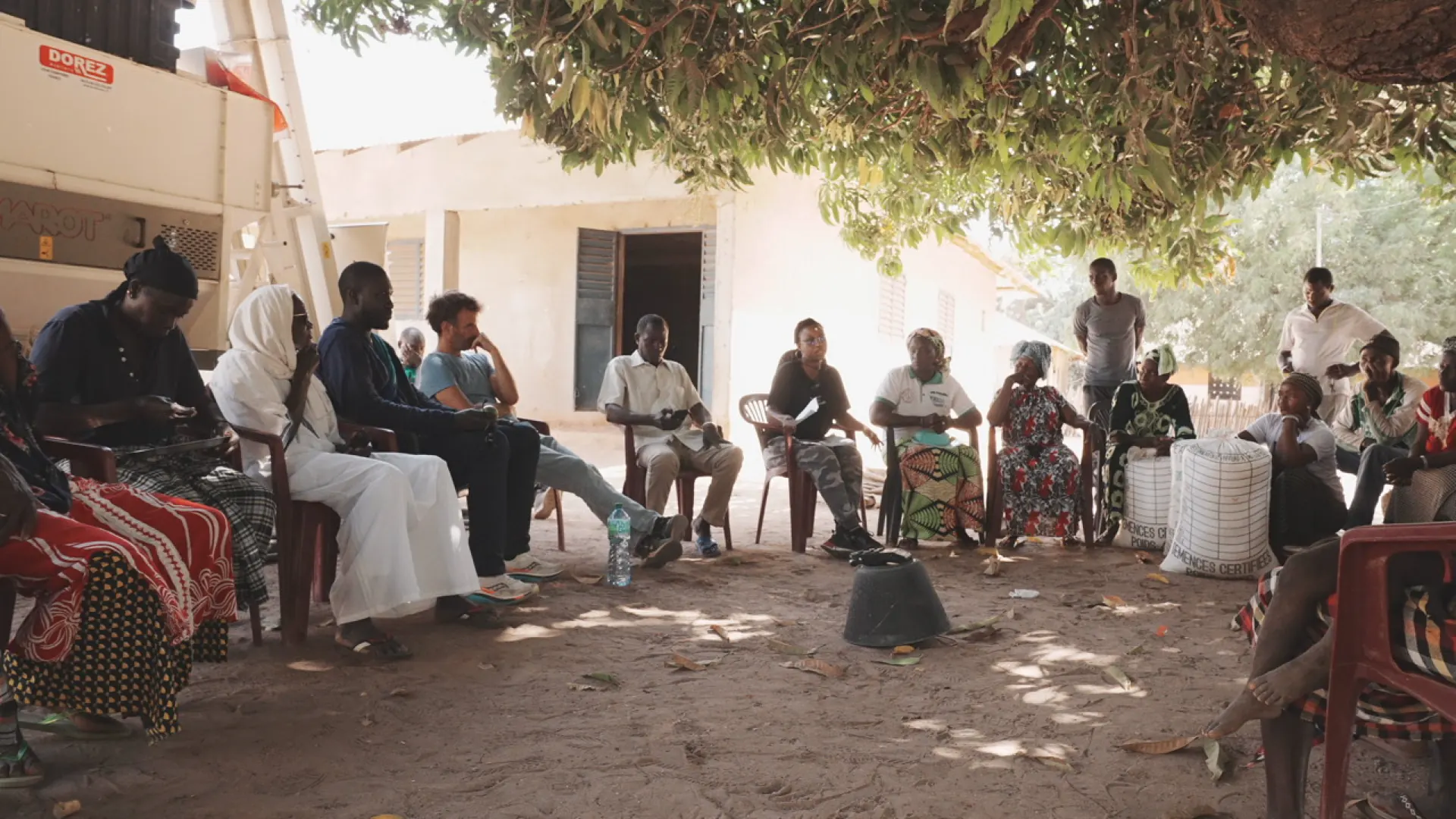
Research is not extractive: it is conducted with and for the people directly affected. Researchers do not stand as external observers but take part in the transformation they study.
- Embedded research
- Scientific analysis is woven into participatory processes at community and territorial level, inside the multi-actor platforms themselves.
- Non-extractive research
- Data sovereignty for communities, local ownership of monitoring tools: you don’t extract, you give back.
- Knowledge co-production
- Workshops are iterative spaces where indicators are co-defined: contextual relevance and local ownership at once.
- Participatory socio-metabolic analysis
- Making flow methods (MFA/SFA), usually expert-driven and heavy, locally relevant and democratically accessible.
Lineage · Bottazzi & Boillat 2021 ; Hilbeck et al. 2023 ; Martinez-Alier 2009
Art as method
Art as a method of inquiry, not decoration
The agroecological transition does not play out only in technical tools or policy: it plays out in imaginaries, bodies, stories, emotions. ARTS makes creation a research method in its own right - a way into what surveys alone cannot reach - and a lever for advocacy.
- Forum theatre as an epistemic tool
- The Augusto Boal tradition carried by the Ka-Reng troupe: the territory’s conflicts are played out, the audience proposes other endings, and tensions no interview would catch surface.
- Bodies take the floor
- An embodied, situated, emotional access to knowledge that the questionnaire flattens.
- Transformative scenario building
- Collectively co-building futures - desirable or to be avoided - through play, live drawing, the staged problem tree.
Lineage · Augusto Boal ; tradition Ka-Reng (Sénégal)
Read the storyThe next frontier
FAIRTILITY: fertility as a question of justice
CREATES extends ARTS into a proposal centered on soil fertility. Its theoretical move: redefining fertility as both a biophysical and a justice-laden property - no longer a mere soil characteristic but the regenerative capacity of socio-ecological systems. The field widens beyond Senegal, toward the cocoa belt of Côte d’Ivoire.
- "Fairtility"
- The fusion of fairness and fertility: fertility as a justice-laden property, co-produced by ecology, practices and political decisions.
- Political ecology of fertility
- Fertility shaped as much by power relations, history and geopolitics as by ecological dynamics.
- "Fairtile trade"
- An alternative benchmark for commodity governance, linking fertility regeneration to fair trade.
Lineage · Blaikie & Brookfield 1987 ; González de Molina & Toledo 2023 ; proposition FAIRTILITY (CREATES / FNS)